



cambridge MASSACHUSETTS
Harvard GSD
Critic: Andrew HOLDER
suckerPUNCH: Describe your project.
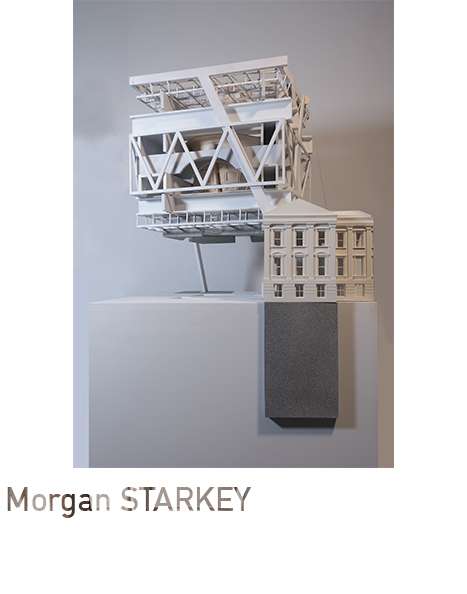
Morgan STARKEY: In late 19th Century New York City, Boss Tweed, the head of the city’s foremost political machine, commissioned the construction of a grand Neoclassical courthouse to ornament City Hall park in effort to establish his parties political dominance.
- Morgan STARKEY, “Mixed Metaphors: The Poetics of Gravity, Empathy, and Machines.”, Section
- Morgan STARKEY, “Mixed Metaphors: The Poetics of Gravity, Empathy, and Machines.”, Elevation
- Morgan STARKEY, “Mixed Metaphors: The Poetics of Gravity, Empathy, and Machines.”, Model Photo
- Morgan STARKEY, “Mixed Metaphors: The Poetics of Gravity, Empathy, and Machines.”, Model Photo
- Morgan STARKEY, “Mixed Metaphors: The Poetics of Gravity, Empathy, and Machines.”, Model Photo
- Morgan STARKEY, “Mixed Metaphors: The Poetics of Gravity, Empathy, and Machines.”, Model Photo
- Morgan STARKEY, “Mixed Metaphors: The Poetics of Gravity, Empathy, and Machines.”, Model Photo
- Morgan STARKEY, “Mixed Metaphors: The Poetics of Gravity, Empathy, and Machines.”, Model Photo
During construction, Tweed infamously embezzled hundreds of millions of (2019) dollars and was later convicted in the unfinished courthouse and sent to prison. The central feature of the building, its Beaux-Arts dome was therefore never completed and the building today is capped by a simple glass atrium. My project seeks to “complete” the project, with an inverted dome held precariously in tension by the weight of a hung prisoner detention mass below. The entire intervention heroically cantilevers over a public plaza, propped on one corner and tied back with a tension member in another. This tension member’s stay is a massive stereotomic anchor that serves as the grand entrance to the courthouse. At every scale, the building attempts to turn the tectonic into the scenographic, choreographing ostensibly inefficient structural solutions with the complex circulation and programmatic concerns required by the modern courthouse. The building is precariously held in balance through this combination of simple machines and props, where an intentional conflation of sociological and physical weight orients the courthouses variety of users through its constituent parts.
sP: What or who Influenced this project?
MS: Early OMA, in particular Rem’s collaborations with structural engineer Cecil Balmond were extremely influential for this project. Maison Domino & Villa Dall’Ava were certainly a launching point, where counterweights and props are employed to nearly surrealist effect. Additionally, post-minimal artists such as Mark di Suvero, Eva Hesse, and of course Richard Serra were continual references. The obsession here focused on architectural and artistic work that used the expressive opportunity of gravity to its fullest extent, in this sense I’d also add Charlie Chaplin to this mix.
sP: What were you reading/listening to/ watching while developing this project?
MS: Kenneth Frampton and Harry Mallgrave’s discourse on tectonics were central to my research. I spent many hours in the studio with Ravel’s Bolero on repeat in a near trance state which I’m sure lead to some bad decisions. Also, I revisited Darren Aronofsky’s latest extremely multivalent film, Mother! several times trying decode how he successfully managed superimposing allegory, myth, and reality onto a relatively simple narrative.
sP: Whose work is currently on your radar?
MS: Formlessfinder, Ensamble Studio, Olgiati and my supremely talented colleagues at the GSD.
