
Ads
Ads


Ads

Ads

Ads

Ads

Ads

Ads

  • negotiable hierarchy
    philadelphia PENNSYLVANIA

    suckerPUNCH: describe your project.

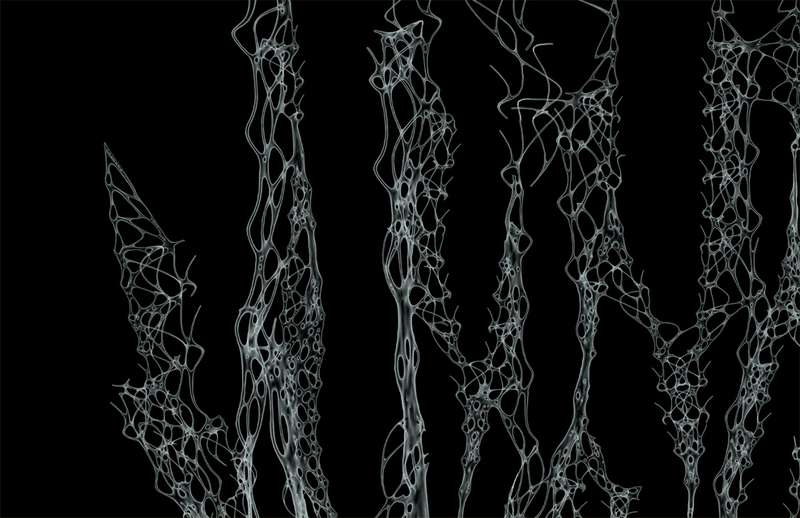
    liwen MAO: this project finds potential geometries that arise within a swarm intelligence system. such bottom up systems can not only create global complex phenomena but also unexpected smaller scale forms and gives the designer more localized control within the system. the project uses curves negotiate between the hierarchies of ornament and structure based on local rules. the advantage of this methodology of form finding is that it can break the limit of human imagination and create unlimited yet reasonable forms by changing specific parameters.

    [MORE]

  • swarm matter
    brooklyn NEW YORK

    kokkugia: swarm matter is an ongoing research project exploring the generation of ornamental geometries through the agent based formation of non-linear hierarchies and emergent patterns.

    kokkugia

    partner: roland SNOOKS

    lead researcher: pablo KOHAN

    software development: alan SONG-CHING TAI

    [MORE]

  • center for non-linear research
    philadelphia PENNSYLVANIA

    suckerPUNCH: describe your project.

    kyu HO CHUN/david ETTINGER/alan SONG-CHING TAI: this project explores the generation of complex topologies through the self-organization of program. a multi-agent design methodology was created to generate a stigmergic interaction of agents seeded with programmatic intent. the project was developed within the complex phenomena research studio that explores non-linear algorithmic design methodologies, directed by cecil balmond and roland snooks.

    [MORE]

  • sky net
    philadelphia PENNSYLVANIA

    the proposal is based on the idea that surface and volume can emerge through the accumulation of lines which self-organize to achieve structure and enclosure. by using the bottom up logic of a dynamic system with embedded intelligence (a multi-agent system) the project achieved biomorphic qualities although its main goal was to meet certain programmatic requirements through the use of simple recursive processes. the advantage of designing through algorithmic procedures rather than directly designing form is that effects can be directly controlled by altering overall behaviors. the process should not be seen as some form of alchemy nor do we believe in letting the algorithm design for us, design intent should be present from beginning to end.

    [MORE]

  • kokkugia@cita
    copenhagen DENMARK

    participants: niels martin larsen, morten bülow, thomas jensen, david wolthers, brady peters, jacob riiber, ragnhild jordtveit kristiansen, malin schaedel, mette høffding, nicolas tai harrison, simon svensson, stine tang jensen, anders rognerud, stephanie chaltiel, mikas jakobsen, caamilla heering petersen, claus rytter brunn de neergard.

    this workshop directed by roland snooks at cita (royal danish academy of fine arts) explored algorithmic design methodologies that engage complex and non-linear systems to generate emergent affects. the one week workshop developed both recursive and self-organising techniques that are capable of generating complex forms of order.

    [MORE]

  • fibrous tower
    new york NEW YORK

    roland SNOOKS: this fibrous concrete shell tower emerged from a series of earlier studies undertaken with rojkind arquitectos into exoskeleton tower typologies. the project compresses the structural and tectonic hierarchies of contemporary tower design into a single shell whose articulation self-organizes in response to commonly conflicting design criteria. the project compresses the structural and tectonic hierarchies of contemporary tower design into a single shell whose articulation self-organizes in response to this often conflicting criteria.

    [MORE]

  • isaw
    new york NEW YORK

    suckerPUNCH: describe your project.
    rolandSNOOKS: isaw is an algorithmic strategy that marries disparate programs in the redevelopment and hyper densification of warsaw’s urban center. this project plays with normative notions of figure ground and posits a programmatic topology which enables two divorced programs – such as a brothel and a monastery – to intertwine, and canoodle unaware of each others presence. each is offered the opposite extreme of the same topology – two schizophrenically different characters in one topology. this can be thought of as a thickening of the walls, the wilful penetration and subversion of one program, deep inside another.

    [MORE]